Via Indigenous Peoples Rights International
In the northern Paraguayan Chaco, three Ayoreo leaders are facing criminal charges after being accused by the National Emergency Secretariat (SEN) in the context of the unjust and insufficient state response to a drought and forest fires that seriously affected their community. The case occurs in a territory where Ayoreo groups live in voluntary isolation; the forest is receding rapidly, and the communities are resisting deforestation. How did an episode of environmental crisis end in a legal case against Ayoreo defenders of their forests?
Rights recognized, realities denied
Paraguay is home to more than 140,000 indigenous people belonging to nineteen Indigenous Peoples. Although the State formally recognizes some of their territorial and cultural rights, there is a serious lack of water, food and basic services in their territories. For many communities, the state presence is manifested more through control and criminalization than through effective protection policies. This situation is clearly reflected in the Ayoreo 2 de Enero community, located in Filadelfia, in the northern Paraguayan Chaco.
The Ayoreo people historically inhabited a territory of more than 30 million hectares, located between Paraguay and Bolivia. However, this territory has been largely privatized, fenced off, and deforested. Today, the communities have increasingly limited space for their subsistence, while the advance of the extractive frontier continues to threaten their ancestral territory.
It should be noted that Ayoreo groups still live in voluntary isolation in this territory, whose survival depends directly on the Chaco forest’s existence and continuity. At the same time, the Paraguayan Chaco is undergoing one of the most accelerated deforestation processes in the world, driven by extensive cattle ranching, monocultures, mining and large infrastructure projects, such as the Bioceanic Corridor, to connect the Atlantic Ocean with the Pacific Ocean, which crosses the northern territory of the Paraguayan Chaco and other southern countries, such as Brazil, Argentina and Chile.
From climate emergency to criminal proceedings
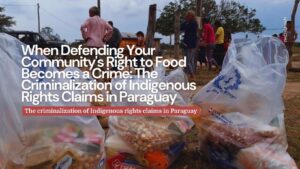
In August 2024, the Ayoreo community of 2 de Enero suffered extreme drought and forest fires. The National Emergency Secretariat (SEN), the state entity responsible for providing humanitarian aid in such climatic emergencies, arrived in the community with insufficient food aid, based on an outdated census that did not reflect the actual number of affected families. Faced with this situation, Ayoreo indigenous community leaders demanded that the food be distributed equitably and in sufficient quantities.
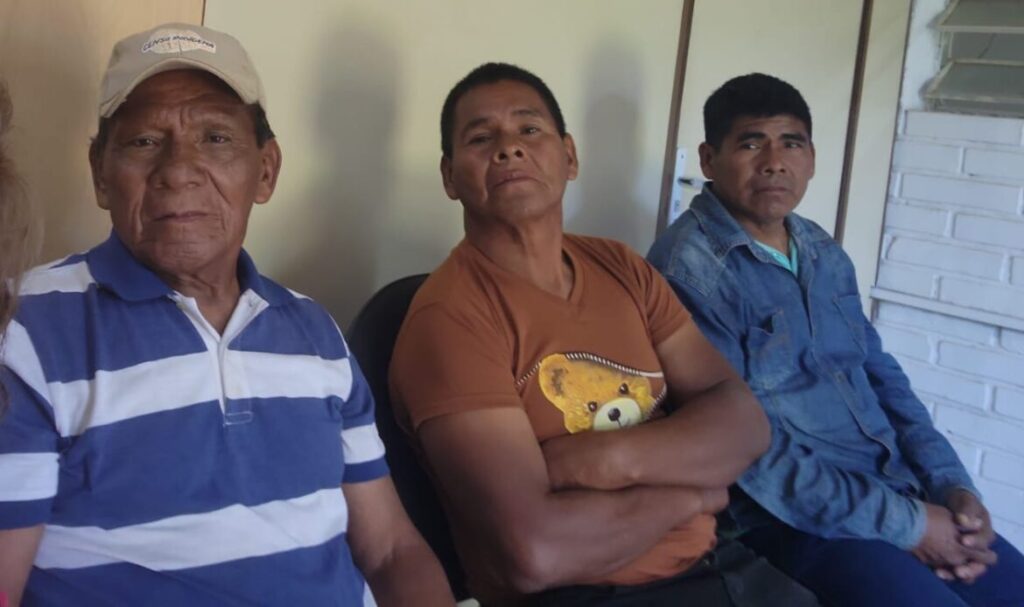
Tension increased when an official took photographs without consent, prompting the community to demand that state workers leave the territory. Shortly thereafter, SEN officials filed a criminal complaint for serious coercion, damage, and disturbance of public peace against three Ayoreo leaders: Jorge Ajihi Chiqueno Pasoraja, Bernardo Chiqueno Pasoroja, and Utocadi Angel Chiqueno.
The case was initially closed. But it was reactivated in 2025 in the context of the territorial defense of several Ayoreo communities, who demanded that landowners stop the deforestation that threatens the Chaco forest and puts at risk both settled communities and the Ayoreo groups in voluntary isolation. The now-criminalized leaders have been an important part of the defense of the forest, as they were signatories to legal actions against deforestation in the Faro Moro area, a process currently before the Supreme Court of Justice.
The case has gone through multiple stages marked by irregularities. In addition to the lack of sense in the accusations, there was an attempt to take statements without a qualified interpreter. The preliminary hearing scheduled for February 2026 was suspended, with a new hearing pending for April 2026.
Currently, the accused indigenous leaders are under alternative measures of imprisonment. Since 2024, they must appear in court every two months to sign in. The entire process forces them to make long and costly journeys from their communities to attend the hearings.
As for possible penalties, they face charges of serious coercion, with sentences of up to 3 years in prison; damage to a thing of common interest, also with sentences of up to 3 years; and disturbing the public peace, which can carry up to a 10-year sentence.
This process has had profound psychological, physical, and economic consequences, often invisible, both at the individual level and in the families of the criminalized leaders and in the community. It not only affects the directly criminalized leaders, but also sends a threatening message to other indigenous communities that are demanding their rights, including the right to Free, Prior, and Informed Consent in the face of projects such as the bioceanic corridor, the international bridge in the Carmelo Peralta area, and the advance of extractive activities in their territories.
The role of the Legal Defense and Sanctuary Fund
Thus, criminalization is part of a strategy that seeks to weaken leadership and community organization in territories where powerful extractive interests are advancing, linked to cattle ranching sectors with strong political influence, grouped in spaces such as the Rural Association of Paraguay and other actors. In this case, it sends a clear message to indigenous communities that defending the forest and life can become a personal risk, leaving them more exposed to reprisals, threats, or new criminal cases. Meanwhile, those who benefit from deforestation and dispossession continue to act with impunity.
This case came to IPRI’s Legal Defense and Sanctuary Fund, a mechanism that provides legal and emergency support to defenders and indigenous communities facing threats due to criminalization, illegal detention, forced eviction or violence because of their work defending and exercising their human rights.
For the Ayoreo 2 de Enero Community, the Fund supports criminalized leaders by providing specialized technical defense and essential resources to sustain the criminal process with greater guarantees. It helps cover legal and logistical costs that would otherwise be a barrier to continuing the defense of the territory and to facing the judicial process.
The accompaniment also seeks to protect community leadership and, therefore, community organization, preventing criminalization from limiting their ability to demand justice and defend their collective rights.
What this case reveals about the State and the justice system
The story of the Ayoreo 2 de Enero community reveals a profound contradiction: when it comes to guaranteeing water, food, or protection from the climate crisis, the State appears weak or absent. But when communities question deforestation, defend life, or demand dignified responses, the state apparatus responds with force through the criminal justice system.
This case shows a justice system that acts with greater severity against those who defend rights than against those who destroy the forest. And it reveals a State that, despite recognizing indigenous rights in its legal framework, still fails to fully guarantee them in practice.