In August 2024, the department of Boquerón in the Paraguayan Chaco was declared an Environmental and Sanitary Emergency. Forest fires. Drought. Destroyed crops. Dried-up water sources. Dense smoke.
Sixty-four Ayoreo families of Community 2 de Enero faced acute food insecurity.
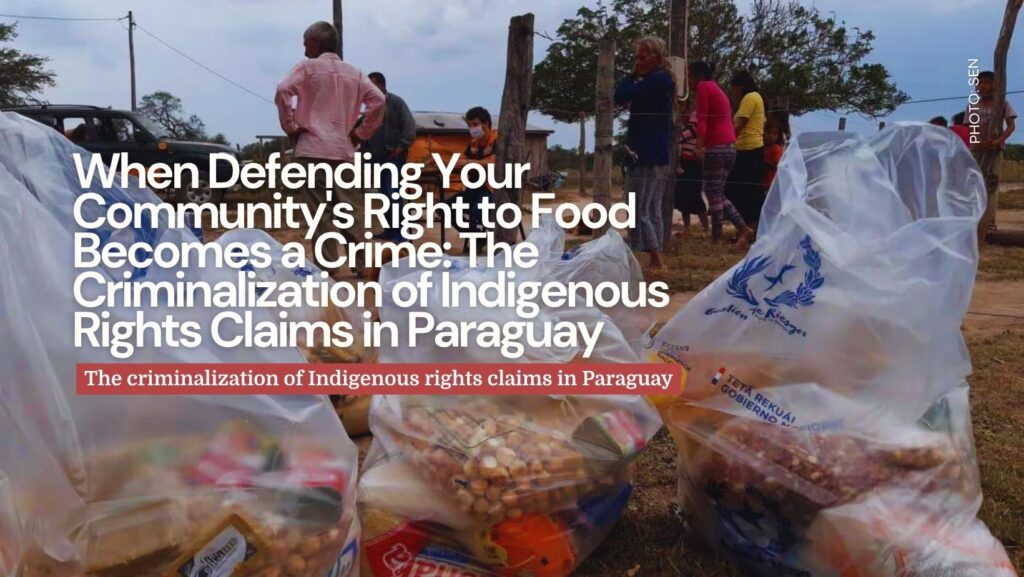
On August 16, officials from the National Emergency Secretariat (SEN) arrived with 61 food kits for a community of 64 families. Three families would receive nothing.
A community leader, the asuté (the highest Ayoreo authority), recognized by State Resolution No. 1521/2011, refused to accept a delivery that would leave three families behind.
The insistence of SEN officials and their arrogant attitude of taking photographs without the authorization of the affected individuals led to the expulsion of SEN officials from community-owned land.
Following this legitimate protest, the next day SEN returned and delivered all 64 kits.
However, the State is now acting in retaliation against these claims for basic rights — the right to life, food, and water — through an irregular legal process that violates human rights and ratified international treaties.
More than a year and a half later, three Ayoreo individuals face criminal prosecution. Serious coercion. Damage to goods of public interest. Disturbance of public peace. All for demanding food during a climate emergency. This also constitutes retaliation against the community for its defense of Ayoreo groups in isolation in the Faro Moro area.
Here is what is at stake:
- No certified Ayoreo language interpreter was provided. The Prosecutor’s Office proceeded anyway, resorting to an unaccredited community member. Absolute nullity under Paraguayan law.
- The special procedure for indigenous peoples (Title VI, Book II of the Criminal Procedure Code) was never applied, even though the prosecuting officer himself identified it as the only applicable avenue.
- The Ethnic Rights Opinion (DD.EE. No. 671), issued by the Public Prosecutor’s own Directorate of Ethnic Rights, requested that the accused be discharged. It was ignored.
After the initial closure of the case by the prosecution — which determined that the community’s action in defense of its rights did not constitute a crime — the guarantees judge decided not to dismiss the case. The same judge had been involved in the Faro Moro case.
The reopening of a case that had already been dismissed, carried out under irregular conditions and without due process, constitutes arbitrary retaliation against this community for its intervention in defense of the Ayoreo in isolation in the Faro Moro area.
A complaint has now been filed for persecution of the innocent (Article 310 of the Criminal Code). The criminal proceedings continue to advance toward a public oral trial.
This is not an isolated case. It is a pattern of criminalization of indigenous leadership in the Chaco. And it is happening while the State fails to fulfill its obligation to guarantee the economic, social, and cultural rights of the Ayoreo people.
The question for the international community, for legal professionals, for human rights mechanisms:
How many more indigenous leaders must be prosecuted for defending their communities before the system responds?